Short answer
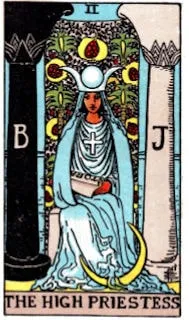
The High Priestess represents intuition, quiet observation and knowledge that is not yet fully apparent in tarot. The card invites you to notice before deciding, leaving room for what you do not yet know.
Upright meaning
Upright, The High Priestess asks for reflection and attentive listening. A feeling can be worth exploring without becoming an unquestioned conclusion.
Reversed meaning
Reversed, the card may suggest ignoring your inner response or filling gaps with assumptions. Separate what you sense from what you can confirm.
The High Priestess in love
In love, the emphasis is on listening and unspoken expectations. A suspicion about another person’s feelings is not the same as knowing them.
The High Priestess and career
At work, this card suits research, concentration and patient observation. You do not need to offer the loudest or fastest answer.
The High Priestess and money
For money, the symbolism points to incomplete information. Treat uncertainty as a reason to ask questions, not as proof that an offer is good or bad.
The High Priestess as a daily card
Find a quiet moment without distractions today. Note what you notice and one question that still needs an answer.
Yes or no?
No clear yes or no yet. Listening and gathering information fit this card better than rushing a decision.
Frequently asked questions
Does The High Priestess reveal a secret?
No. Hidden knowledge is a symbolic theme, not evidence that someone is concealing something. An open question is more useful than an accusation.
How does she differ from The Magician?
The Magician emphasizes action and expression. The High Priestess emphasizes observation and what is not ready to be acted on.
These texts are original, contemporary interpretations of tarot as symbolic reflection. Meanings, reversals and yes-or-no readings vary between traditions. Historical background for Rider-Waite-Smith symbolism: A. E. Waite, The Pictorial Key to the Tarot.