Short answer
Death represents the end of a phase, letting go and transformation in tarot. In this symbolic reading, the card concerns making room for something new, not predicting a person’s death.
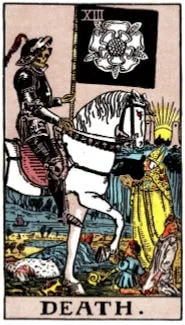
Upright meaning
Upright, Death suggests recognizing that something has served its purpose. Acknowledge what is ending and allow time to adjust.
Reversed meaning
Reversed, Death may reflect resisting change or holding onto an exhausted pattern. Ask what is difficult to release and why.
Death in love
In love, an old way of relating may need to change. The card does not automatically mean a breakup; sometimes a habit is what ends.
Death and career
At work, Death suits leaving a role, method or expectation behind. Consider what experience to carry forward and what no longer fits.
Death and money
For money, the symbolism concerns changing habits or your relationship with possessions. It does not predict a loss or financial disaster.
Death as a daily card
Finish one small thing that has been waiting for your attention. Making space can start with an object, an agreement or an outdated expectation.
Yes or no?
A leaning toward no to continuing unchanged, and possibly yes to renewal. The interpretation depends on what you want to preserve or transform.
Frequently asked questions
Does the Death card mean someone will die?
No. A drawn tarot card cannot establish or predict a death. Death is interpreted here as closure and transition.
Is Death always a negative tarot card?
No. An ending can be difficult while also creating space. The card invites you to acknowledge both sides of change.
These texts are original, contemporary interpretations of tarot as symbolic reflection. Meanings, reversals and yes-or-no readings vary between traditions. Historical background for Rider-Waite-Smith symbolism: A. E. Waite, The Pictorial Key to the Tarot.